
International Law for Thee, but Not for Me: The Trump Administration’s War on the ICC
The US helped build the world order that led to the creation of the ICC. Why is the Trump administration trying to dismantle it?
Mike Brand
7/14/20267 min read
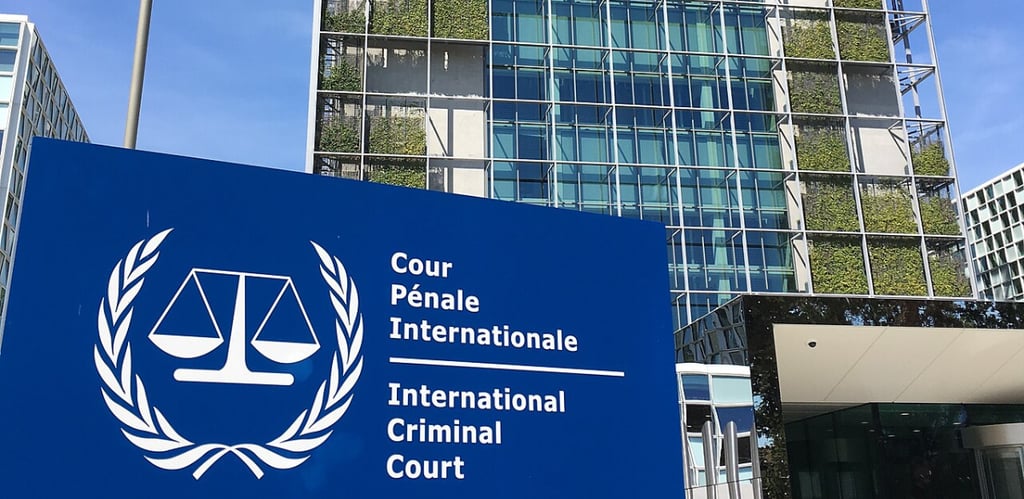
The Trump administration is afraid of accountability. That is the only conclusion to draw from Secretary of State Marco Rubio’s declaration that the United States will seek to “dismantle the ICC—brick by brick, if necessary.”
In a remarkable statement published by the State Department, Rubio portrays the International Criminal Court (ICC) as an existential threat to American sovereignty. He warns that US soldiers, law enforcement officers, and political leaders could someday be “dragged before an international court” and judged by foreign judges and juries.
But Rubio leaves out an important fact: the ICC is a court of last resort that exists to prosecute crimes of genocide, war crimes, and crimes against humanity--often referred to as mass atrocities. The ICC does not exist to prosecute ordinary criminality or replace effective national court systems. Under the principle of complementarity, the ICC it is intended to step in when national authorities are unwilling or unable genuinely to investigate and prosecute the gravest international crimes.
If American leaders are terrified that an international court may someday scrutinize allegations of war crimes or crimes against humanity, the answer is not to dismantle the court. The answer is to comply with international law and ensure domestic accountability when violations occur.
Accountability for Our Enemies, Impunity for Ourselves
Rubio’s hypocrisy is particularly striking because only a few years ago he supported international investigations of Vladimir Putin and Russian officials for war crimes committed in Ukraine.
In March 2022, close personal ally of President Trump, the late Senator Lindsey Graham, led a Senate resolution encouraging ICC member states to petition the Court or another international tribunal to investigate war crimes and crimes against humanity committed by Russian forces and Putin’s commanders. Marco Rubio was a lead cosponsor. The resolution passed the Senate unanimously.
Graham celebrated when the ICC issued an arrest warrant for Putin stating, “The decision by the ICC to issue an arrest warrant for Vladimir Putin is a giant step in the right direction for the international community. It is more than justified by the evidence. To forgive and forget Putin’s war crimes – that are occurring on an industrial scale – would irrevocably damage the Rule of Law-based world order established at the end World War II.”
Several Senators, including Graham, even wrote a letter to President Biden in 2023 urging his administration to support the ICC investigation by sharing intelligence and evidence of Russian war crimes with the Court.
Apparently, international justice was acceptable to Rubio and others when Vladimir Putin was the target. Now that Rubio fears the same body that upholds international law could scrutinize the United States or its allies, the Court has suddenly become a threat to American independence.
This is not a principled objection to international justice. It is a demand for selective accountability. International law, in this worldview, is a weapon to wield against adversaries and an intolerable violation of America's sovereignty when it might apply to us.
Further, Rubio’s statement essentially argues that if violations of international law are perpetrated in a country by a foreign national, the perpetrators are exempt from prosecution. Essentially, Rubio is arguing that if Ukraine wanted to hold Russian soldiers accountable for war crimes committed in Ukraine, that would violate Russia’s sovereignty. A claim that many in the US would likely not endorse.
International Law Cannot Be Optional for the United States
Rubio himself regularly invokes international law when it advances US interests. Earlier this year, when discussing Iranian threats to commercial shipping in the Strait of Hormuz, Rubio stated emphatically that Iran could not impose tolls on an international waterway, citing existing international law to make his argument.
Though, in what seems to be a pattern from this administration, the hypocrisy is glaring as President Trump announced the US would impose its own toll on ships passing through the Strait as a reimbursement for “providing safety and security to this very volatile section of the World.”
The principle Rubio invoked is important; states cannot simply ignore international law because it would advance their interests. However, it would appear that Secretary Rubio and President Trump do not believe this principle applies to the US.
The US government cannot demand respect for international law in the Strait of Hormuz, invoke the laws of war against Russia in Ukraine, demand accountability for atrocities in Sudan, and then declare that international law must never constrain Americans.
The hypocrisy is even more glaring when Rubio argued that Americans should never face foreign judges or legal systems the United States does not “consent to or control.” The Trump administration recently deployed the US military to invade Venezuela, abduct Nicolás Maduro, and transport him to the United States to face criminal charges in an American courtroom.
Whatever one thinks of Maduro or his government, the contradiction and blatant hypocrisy are impossible to ignore.
The United States claims the authority to enter another country, capture its leader, transport him thousands of miles away, and place him before an American judge and jury. Yet Rubio asks Americans to recoil at the possibility that an American accused of grave international crimes could face an international court.
International law only works if it is applied equally and universally.
The United States Is Hardly Defenseless Against the ICC
Rubio’s portrayal of a helpless America under siege by an all-powerful global tribunal is laughable. The United States is not a State Party to the Rome Statute. Congress has already enacted the American Servicemembers’ Protection Act—infamously nicknamed the “Hague Invasion Act”—which authorizes extraordinary measures to protect US and allied personnel from ICC custody.
The Bush administration also pursued bilateral Article 98 agreements with foreign governments intended to prevent countries from surrendering covered US persons to the Court’s jurisdiction. The Trump administration has gone even further, imposing crippling sanctions on ICC officials. Targeting judges and prosecutors associated with the Court’s work with the same sanctions authorities the US government uses to hold perpetrators of the very crimes the ICC investigates.
All of these immoral layers of protection are apparently not enough for the Trump administration. Rubio wants to dismantle the Court entirely. That should tell us something about how deeply this administration fears accountability.
The ICC Is a Court of Last Resort. Domestic Justice Mechanisms Need to Step Up
The principle of complementarity raises a more uncomfortable question for Americans: are we ever willing to hold our own leaders and officials accountable for violating international law?
The ICC is supposed to complement, not replace, national courts. The US should demonstrate that its own institutions are capable of investigating and prosecuting serious violations of domestic and international law.
Perhaps if past justice efforts were pursued, successive administrations would feel more accountable to the laws they are meant to uphold. Yet, for decades, across both Republican and Democratic administrations, violations of international law continued with full impunity. And these violations were not aberrations; they were consistent state policy endorsed from the president on down.
The United States operated a global torture and extraordinary rendition program after 9/11. Detainees were subjected to waterboarding, sleep deprivation, stress positions, and other forms of abuse. Yet senior officials who designed, authorized, and legally justified the program largely escaped criminal accountability.
Successive administrations dramatically expanded drone warfare across multiple countries. US strikes routinely killed civilians, including children. The Obama administration authorized a strike that killed Anwar al-Awlaki, a US citizen, without trial, and another US strike killed his 16-year-old son. In 2021, a US drone strike in Kabul killed ten civilians, including seven children. The Pentagon ultimately acknowledged the strike was a “tragic mistake.” The Trump administration has killed more than 200 people with strikes in the Caribbean. No existential threat. No justification. No due process. Just violations of international law.
These are not reasons to dismantle international law. They are reasons for the US to strengthen its own systems of accountability and oversight while reining in the casual use of military might that all too often results in avoidable civilian death. If the US does not want international institutions investigating alleged American crimes, then we must be willing to investigate ourselves credibly, transparently, and independently.
The answer to the ICC is not impunity. It is domestic accountability and a paradigm shift in the way the US uses kinetic military operations globally. A shift toward a prevention-focused foreign policy and a recognition that hypocrisy in our foreign policy actually is a threat to national security would be a step in the right direction.
America Helped Build the System Rubio Wants to Tear Down
Rubio presents international criminal law as an alien “globalist” project imposed on the United States. However, history tells a different story.
After World War II, the United States helped lead the International Military Tribunal at Nuremberg. Supreme Court Justice Robert Jackson served as the chief US prosecutor against senior Nazi leaders. The United States also played a central role in establishing the Tokyo Trials.
Those tribunals were imperfect and have rightly faced criticism for selective justice. But they helped advance a revolutionary principle that government officials and military leaders cannot hide behind state sovereignty when they perpetrate grave international crimes.
Decades later, the United States strongly supported the international tribunals established for the former Yugoslavia and Rwanda to hold perpetrators of genocide, war crimes, and crimes against humanity accountable. In many ways, the ICC was the successor to the ad-hoc tribunals in Rwanda and Yugoslavia.
While Rubio treats international criminal justice as a foreign concept that is a threat to American sovereignty, the truth is that the US helped build this system.
America Needs Self-Reflection, Not Exceptionalism
The Human Security Project has consistently argued that US foreign policy cannot be credible when the United States invokes international law selectively. We cannot invoke international humanitarian law in Ukraine and dismiss it in Gaza. We cannot demand accountability for mass atrocities in Sudan while sanctioning international judges and prosecutors when their work becomes politically inconvenient.
The United States needs serious self-reflection about what it means to claim leadership on human rights and international law. Our government and the American people cannot continue to claim the mantle as a force for good in the world while routinely violating international law and arguing that America is exempt from accountability.
Living up to those values requires more than speeches, sanctions, and State Department reports documenting abuses in other countries. It requires a willingness to examine our own conduct—from torture and unlawful detention to drone strikes and other violations of international law.
The ICC is not beyond criticism. Its effectiveness, jurisdiction, prosecutorial decisions, and unequal application of justice deserve serious scrutiny. Justice is often far too slow and inconsistent. Though this can partially be attributed to limited enforcement mechanisms and a lack of state cooperation. But threatening to dismantle the court because it might investigate Americans or Israelis is not reform. It is intimidation and a full-throated endorsement of impunity for mass atrocities.
A government confident in its adherence to the law does not need to dismantle courts. A country that demands accountability for its enemies cannot insist on permanent immunity for itself.
If international law applies to Putin, to Iran, to Maduro, then it must apply to the US, Israel, and its allies.
Human Security Project
Delivering bold, actionable interventions to prevent violence, protect people, and build human security.
Connect
Engage
© 2025. All rights reserved.